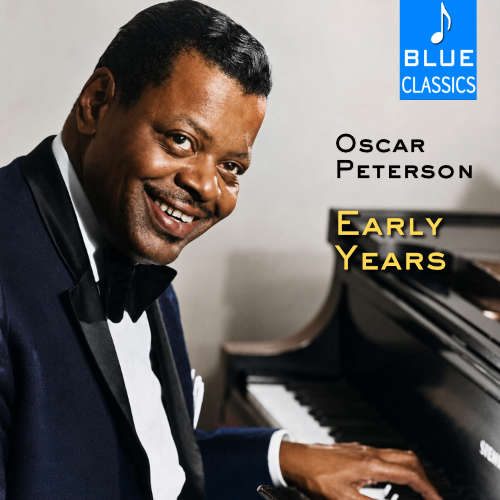
Title: EARLY YEARS
Year: 1951
Category: JAZZ,PIANO,BLUECLASSICS
- 1. Oscar's Blues 03:10
- 2. For You 02:05
- 3. Pennies from Heaven 02:32
- 4. Whispering 01:49
- 5. Body and Soul 03:21
- 6. Flying Home 01:50
- 7. Hungarian Dance No. 5 03:02
- 8. Gypsy in My Soul 02:59
- 9. I Don't Stand a Ghost of a Chance with You 02:32
- 10. I'm Forever Blowing Bubbles 02:19
- 11. I Got Rhythm 02:43
- 12. Tea for Two 02:55
- 13. The Man I Love 02:34
- 14. Rose Room 02:34
- 15. Yesterdays 03:19
- 16. Seven Come Eleven 01:44
- 17. Just You 01:58
- 18. To a Wild Rose 02:34
- 19. Air Mail Special 01:51
- 20. Night and Day 03:38
- 21. Get Happy 01:38
- 22. Laura 03:27
- 23. These Foolish Things 03:23
- 24. You Go to My Head 03:54
- Oscar Peterson – piano
Track 1:
Ray Brown – bass
Recorded March 1950, New York
Tracks 2–21:
Austin Roberts – bass
CBC radio transcriptions, 1951
Track 22:
Ray Brown – bass
Recorded January 19, 1951, New York
Tracks 23–24:
Ray Brown – bass
Irving Ashby – guitar
Recorded January 26, 1952, Los Angeles

EARLY YEARS
by Oscar Peterson with Austin Roberts, Ray Brown
These recordings bring together a selection of performances from the early years of Oscar Peterson's career, spanning 1950 to 1952 and documenting several stages in his development as a pianist and ensemble musician.
Peterson was born in Montreal in 1925 and began studying piano at an early age. His training combined classical studies with an increasing interest in jazz, and by his teenage years he was already performing professionally. In the 1940s he became a familiar figure on Canadian radio and in Montreal clubs, and in 1947 he formed his first regular trio with Austin Roberts on bass and Clarence Jones on drums. The trio performed regularly at the Alberta Lounge in Montreal, with their appearances also being broadcast on radio.
Austin Roberts was therefore an important figure in Peterson's early professional life. The performances represented here from 1951 come from Peterson's work with Roberts in a series of Canadian Broadcasting Corporation radio transcriptions. Rather than conventional commercial studio recordings, these performances were made for broadcasting and preserve Peterson in an intimate two-person setting with bass. The repertoire ranges widely across American popular song and jazz standards, including For You, Pennies from Heaven, Whispering, Body and Soul, Flying Home, Hungarian Dance No. 5, Gypsy in My Soul, I Don't Stand a Ghost of a Chance with You, I'm Forever Blowing Bubbles, I Got Rhythm, Tea for Two, The Man I Love, Rose Room, Yesterdays, Seven Come Eleven, Just You, To a Wild Rose, Night and Day, Air Mail Special, and Get Happy.
These performances belong to a period when Peterson was still primarily known in Canada. His playing was already technically developed, but his international career had not yet begun. The radio work with Roberts provides an opportunity to hear Peterson outside the larger ensemble settings in which he would later be heard, with the bass functioning as an equal musical partner and the piano carrying both melodic and rhythmic responsibilities.
Also included here are several recordings with Ray Brown, whose collaboration with Peterson would become central to the pianist's career. Oscar's Blues belongs to an earlier stage of their association, from 1950, while Laura, recorded in January 1951, shows Peterson and Brown in another intimate setting.
Ray Brown had arrived in New York in 1945 and quickly became part of the emerging bebop scene, working with musicians including Dizzy Gillespie and Charlie Parker. His subsequent association with Norman Granz and Jazz at the Philharmonic brought him into contact with Peterson. Their musical partnership would continue for many years and eventually become one of the principal foundations of Peterson's trio work.
The final two performances on this collection, These Foolish Things and You Go to My Head, introduce another important musician from Peterson's early American career: guitarist Irving Ashby. Ashby had been a member of the Nat King Cole Trio from 1947 to 1951. When Peterson began to establish himself in the United States, Ashby became the guitarist in his own trio, alongside Ray Brown.
These performances were recorded in Los Angeles on January 26, 1952. They belong to the beginning of a new phase in Peterson's career, following his emergence on the American jazz scene. Peterson's use of guitar, bass, and piano reflected the possibilities of the piano-guitar-bass format that had become associated with the Nat King Cole Trio, while allowing Peterson to develop his own approach.
The contrast between the different groups represented here is significant. The Austin Roberts recordings belong to Peterson's Canadian broadcasting years, when radio was an important part of his professional life. The Ray Brown recordings show the beginning of a partnership that would become a defining element of his later career. The Irving Ashby/Ray Brown performances belong to the period when Peterson was establishing himself in the United States and developing the trio format that would soon become internationally recognised.
By 1952 Peterson was already moving rapidly into a new stage of his career. His meeting with Norman Granz and his appearances with Jazz at the Philharmonic brought him to a wider audience and connected him with some of the leading musicians of American jazz. Within a few years, the Peterson–Brown partnership, with Herb Ellis joining on guitar in 1953, would produce a large and influential body of recordings.
Taken together, these performances offer a view of Peterson before that later period was fully established. They document his work in Canada, his early relationship with Ray Brown, and his first trio recordings with Irving Ashby. Rather than representing a single session or a single ensemble, the collection follows Peterson through several closely connected stages in the development of his professional career.
EU Public Domain Notice
The historical sound recordings included in this release are in the public domain in the European Union. Blue Music Group has created a new digital restoration and mastering of these historical recordings. The digital restoration and mastering by Blue Music Group are protected by applicable copyright and related rights. Rights may differ in other territories, including the United States. This release is not intended for distribution in the United States.
Cover artwork: The original photographic image has been legally assessed as being in the public domain in the EU following the expiry of the applicable 50-year term under Section 49a. The image has been restored, enhanced and colorized by Blue Music Group. © Blue Music Group. All rights reserved.